
ISP 16- Advertising

NOTETAKING TASK

How did consumerism change in the 1950s

  • Consumerist culture is understood as composed of the commonly understood symbols, language, values, beliefs and norms of a society.
  • Consumer Culture is a large part of what you do, what you value and how you are defined.
  • The spread of British and American consumerism in the 50s impacted various stages of society. Industrial production levels led to an increase in goods and services. Furthermore, the mass consumerism led to social changes, demonstrated heavily by the youth during this time period.
  • The 1950s saw a period of massive economic expansion in the United States as well as the UK, which lead to the development and growth of suburbs.
  • Consumerism is in regards to the period of time whereby there was a marked increase in the consumption and variety of luxury goods and products by individuals from different economic and social backgrounds. Therefore the post-war period is essential to this as families began to have more disposable incomes to spend on more luxury items as the economy recovered.

Post-war economic boom

  • The post-World War 2 economic expansion, also known as the golden age of capitalism and the postwar economic boom was a broad period of worldwide economic expansion beginning after WW2 and ending with the 1973-1975 recession.
  • America and England both saw periods of the post-war boom, with disposable incomes allowing families to spend on luxury items such as cars, which they may not have been able to afford beforehand.
  • There was also a continued government funding for research into areas such as innovations into technology, aerospace industry and scientific research.
  • As newly trained scientists, business leaders and workers turned their attention to producing new inventions. (primarily televisions and radios)
  • Sales ensured that corporations grew bigger and more profitable.
  • New technologies allowed for factories to employ less workers
  • Increase amounts of people working in offices
  • Farmers also benefited, as there were the production of new machines, chemical fertilizers and pesticides revolutionising agriculture.

Increase in Feminist Ideologies

  • Feminism is a range of social movements, political movements and ideologies that aim to define, establish and achieve the political, economic and personal and social equality of the sexes. This mainly focuses on the equal rights for women

3 Waves of Feminism

  • The first wave promoted equal contract and property rights for women, opposing ownership of married women by their husbands. By the late 19th century, feminist activism was primarily focused on the right to vote. American first-wave feminism ended with passage of the 19th Amendement to the US Consitution in 1919, granting womens voting rights.
  • 21 November 1918- the Parliament (Qualification of Women) Act 1918 was passed, allowing women to be elected into parliament.
  • The women’s sufferage in the UK was a movement to fight for women’s right to vote. It finally succeeded through two laws in 1918 and 1928.
  • Second-wave feminism during the 1960s-80s focused on the issues of equality and discrimination. The slogan “The personal is political” identified womens cultural and political inequalities as inextricable linked and encouraged women to understand how their personal lives reflected sexist power structures. Betty Friedan was a key player in second-wave feminism.
  • Third-wave feminism began in the early 1990s, responding to the perceived failures of the second wave and to the backlash against the seond-wave initiatives. This ideology seeks to challenge the definition of femininity that grew out of the idea of the second-wave, arguing that the second-wave over-emphasized experiences of upper-middle class white women. It examines issues related to women’s lives on an international basis.

Second-Wave feminism

  • A wave of feminism in the United States and UK came as a delayed reaction against the renewed domesticity of women after WW2: the late 40s boom, which was an era characterised by an unprecedented economic growth, a baby boom and a move to family-oriented suburbs.

Mid-20th century baby boom

  • The middle of the 20th century was marked by a significant and persistent increase in fertility rates in many countries across the world, especially in the west, resulting in the famous baby boomer generation.

Persil 2006 Advert
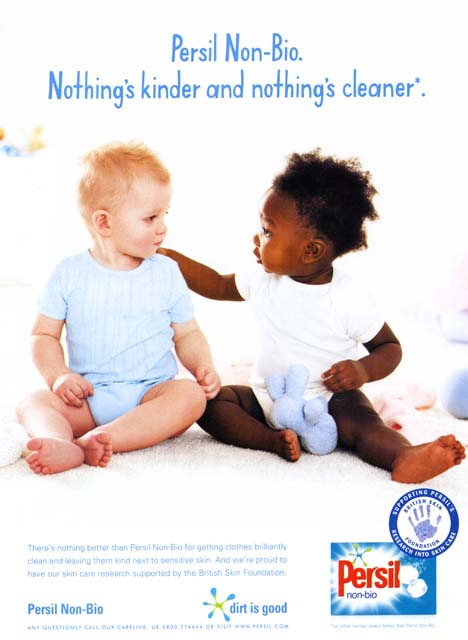
Image result for persil advert 2006

The Persil 2006 advertisement includes the positioning of having two babies in the centre, this therefore highlights the main focal point of the advertisement. Furthermore, including two babies implies a domestic and nurturing element to the product, potentially aiming at parents viewing the adverts. This may provoke a sense of reaction from the audience with the children looking at each other curiously. The light and basic colour scheme of the advert reflects this sense of cleanliness in the products which the babies are wearing, whilst also making sure to highlight the two children in the centre through the use of high-key lighting in the background. The text reinforces what the print is advertising and the font “Nothings kinder and nothings cleaner” allows the audience to trust the product, this is further demonstrated by the child-like font, therefore suggesting that the product is so gentle that babies can wear it. The inclusion of having multi-race children highlights the words “kinder” reflecting society’s attitudes and beliefs changing and people becoming more considerate at a younger age. Due to the domestic connotations the product has, it could be viewed as targeting a specific audience of mothers.

Coca Cola 60s Advert

coca cola advert

This 60s advertisement highlights the change in societies attitudes, the inclusion of a woman with the large text associating her with “home and hospitality” highlights the viewpoint of women being seen as the provider to her family, this is also reciprocated by the image depicting a woman shopping along with the lines “for the family…”. This advertisement is aimed at middle-class white women of the time period in order to make them purchase coca cola alongside their usually shop, this is shown through the contradiction of neutral toned colours that the woman is wearing in comparison to the strong brand associated red coca cola bottles. The woman is depicted as happy and therefore satisfied with the product, insinuating that the coca cola should be bought rather than other drink products. The product is placed in a large section of the image shot, with the slogan being visible reading “delicious and refreshing”.  The smaller image reinforces this iconography of the coca cola bottles to represent to the audience that this is the advertisement for the product, it also has a patronising nature to the advert through it instructing the audience to put the bottles in the fridge “and serve ice-cold”, implying that consumers have to be given instructions.


Exam Question

Zoella: Explain how representations of identify are constructed in blogs and vlogs

Zoella is a 29 year old social media influencer and YouTuber, she creates videos on YouTube for her audience and currently has over 10 million subscribers. In recent years her main channel consists of more professional style filming including sets whereas she has a second channel where many of her vlogs are based. The style of editing in the videos are primarily pink and pastel colours to go along with her girly theme. Zoe aims at a teenage female audience as they are most likely to watch makeup related videos and blogs as well as read articles on her blog. The female audience of Zoella’s YouTube channel are also able to interact with her on social media with Q&A’s that she posts, allowing fans to feel more welcomed and invited by her.

Zoe’s blog includes handwritten style fonts and decorative images, the articles on the blog cover topics such as ‘Out top vegan spots in Brighton’, making her life personalised with the reader and providing readers with suggestions which they can then decide to do. Her YouTube channel is similar to this, with videos such as ‘My everyday makeup routine’ giving viewers the tools and resources to mimic her lifestyle whilst receiving tips and instructions on how to recreate the look. This strong use of makeup and fashion is apparent on her YouTube channel, blogs and social media. Halls’ theory states that the media language connotes that Zoella is instructing her audience as she holds an impressionable influence on her audience, especially when they are teenagers as they are only starting to construct their own identities.

There is a strong appeal throughout her online media towards female fashion, self-care and makeup. This is also shown in her brand where she sells bath and body products, which in its launch, according to the Metro was the biggest beauty launch of the year. She promotes her brand through her YouTube and social media, which on average appeals to the young female generation. However, it could be argued that this target towards a feminine audience is more of a social construct rather than fact. Users of her blog are able to construct their own identities by following her tutorials, reviews and copying her fashion style. This fashion style is represented in her blog, with links to purchase the outfits displayed and promoted. Gauntlett’s theory of identity includes this allowance of audiences replicating Zoella’s fashion style, whilst also giving Zoella her own ‘brand’ of style. Fans of Zoella are also able to mimic her social media pages, with her new creation of ‘Template’, an app that provides users with designs and templates that they can use to ‘spice’ up their Instagrams, whilst also promoting Zoellas style and making it become a ‘trend’ with teenage female social media pages.

Vance Joy comparison


  • blue and white colour palette, less colour diverse to riptide

Vance Joy ‘Fire and the Flood’ compared to Riptide

Similarities

  • Use of closeups
  • Invisible edits
  • Two abstract aspects of the videos, just riptide has it all the way throughout

Differences

  • Location: set in one setting
  • Editing: Riptide Montage
  • tracking shots- long takes
  • Riptide had less literal/metaphorical meanings
  • FATF- Narrative based, non-linear narrative
  • Riptide: fragmented narratives
  • Performance: star persona, showing his face in this video compared to riptide.

Intertextuality: the way in which texts gain meaning through their referencing or evocation of other texts.

Meanings can be produced/implied through intertextuality.

Parody: Mimicry of an established concept, idea or a person with deliberate exaggeration for comedic effect.

Satire: humour that stands for a social or political change. It depicts an anger of frustration while trying to make the subject palatable. Its mockery but not mimicry. Trying to make society to think about an issue whilst parody does not.

Pastiche: A work that imitates the style or character of the work of one or more other artists as a form of celebration or tribute to the original.  Known as the concept of music being replicated by other artists. “Great artists steal”

How riptide uses intertextuality

Western Iconography- Not a whole meaning other than to reference the literal meanings of the film

Reference to the horror film “Don’t look now” – blonde woman wearing red.- Reference to the horror element in feminine features in riptide

Cinematography References:

  • Wes Anderson
  • Roger Deakins
  • David Lynch

Reference to Wes Anderson’s ‘Hipster’ films- Reflects the style of riptide, symmetrical shots and costume and colour grading. The effect of having something visually central creates a focus point

Reference to The Assassination of Jesse James (2008), a Roger Deakins style of having a silhouette on a dark background

Reference to David Lynch’s film ‘Blue velvet’, the singer that is pictured ‘singing the words wrong.’

Hipster Culture

Hipsters are a subculture of men and women typically in their 20s and 30s that value independent thinking, counter-culture, progressive politics, as appreciation of art and indie-rock, creativity, intelligence and witty banter.

They are pioneers and leaders of the latest cultural trends and ideals. Hipsters reject the culturally-ignorant attitudes of mainstream consumers, and are often seen wearing vintage and thrift store inspired fashions.

Surrealism

Is a 20th century movement in art and literature which sought to release the creative potential of the unconscious mind, for example by the irrational juxtaposition of images.

Avant-garde: experimental

To what extent can Riptide be classified as a surrealist piece of art?

  • Many shots of women running away- as if they dont know they are being filmed
  • Possible reference to abuse through the smeared makeup
  • Women looking from a balcony- independence

Use of weapons- bondage

Why have these images been used in the music bifeo and could they be interpreted as trivialising or normalising violence?

The video construct a range of different stimuli that the audience are invited to interpret

The video rejects singular, straightforward messages and instead invites a variety of different responses and interpretations.

Women as objects

Revisiting the video again, identity shots where women are presented as ‘objects’.

Consider whether these images of women are sexualised and offered to audiences for their pleasure (Mulvey GCSE theory)

  • Domestic violence
  • Uncomfortable- “lump in my throat”
  • Stereotypes- interpret either positive or negative in regards to beauty
  • Exploited women- highkey lighting and vulnerability and harsh.
  • Lyrics- the subtitles are wrong, shes being humiliated by singing the words wrong
  • Subversion of beauty
  • Highkey to lowkey, represents society as hushing violence

Riptide Vance Joy

  • Vance Joy is an Australian singer-songwriter signed to Atlantic Records (a subsidiary of major label, Warner). His music can be categorised as fitting into indie folk-pop genre.
  • Riptide was Vance Joy’s first single to be released in the USA (2013) following his debut EP “God loves you when you’re dancing”. It became a platinum selling single.
  • The video was directed by Dimitri Basil and Laura Gorun and has more than 350 million views.

Bathes Semiotics Theory

The pile of dollar bills which accompanies the line “oh, all my friends are turning green”, connotations of the colour green in relation to both money and envy. This example of polysemy could be interpreted in a variety of ways e.g. is it implying that friends (possibly in other bands) have ‘sold out’ by giving into money? Or might these friends be turning green with envy at the success of Vance Joy.

Connotations-

Increasingly darker lighting throughout the scenes of the woman getting the lyrics wrong.

“dark side”, reference to ghosts and demons.


Denotations-

“and they come unstuck”, with the shot of lolipop stuck together

This cowboys running from himself

Genre-

Anchorage-

Anchorage is when a piece of media uses another piece of media to reduce the amount of connotations in the first, therefore allowing the audience to interpret much more easily.

Editing-

Quick camera movements

Jump cuts-


IMG_1579

Montage editing is used in an overt way- a wide range of contrasting shots

Juxtaposed (often through hard jump cuts) to convey a large amount of information:

  • The editing together of seemingly disparate images invites audience interpretation and candidates could consider Einstein’s concept of “intellectual montage” where new ideas emerge from the collision of images and generate new meanings that might not otherwise exist.
  • Many of these cuts also have a link to the lyrics themselves and you should explore the visual metaphors and possible significance of these edits in relation to the lyrics.


I, Daniel Blake ISP

I, Daniel Blake pack

Explain what you understand by intertexuality. Refer to the set episode of Life On Mars to support your response.

Life On Mars is a British crime drama, the television show subverts from typical themes by implementing the science-fiction genre into the show, giving it a unique selling point to the viewer. The dynamic of the genre is shown in the show through Steve Neale’s genre theory. The use of police uniforms, cars and stations apply directly to the genre. However, it subverts from stereotypical police programs by having a 2006 show set in the 70s. Life On Mars has adapted from taking elements from both genres and combining it together.

Whilst Life On Mars could be viewed as a conventional police procedural, these stereotypical conventions are challenged when Sam is hit by a car and travels back in time. The mise-en-scene completely changes highlighting the change in time period and characters reflecting the disruption from conventional police procedural. The show mimics the 70s show The Sweeney, creating a nostalgia for the audience whilst contradicting some of these attitudes to suit a modern-day audience. Therefore the attitudes and opinions were vastly different to 2006. For example, the character of Gene Hunt being represented as a toughened cop, directly reflecting the character of Jack Regan. Sam Tyler, from the era of 2006, alongside the modern-day audience are able to recognise comments made by Gene Hunt and therefore highlight the change in societies attitudes towards gender and race. Gilroy’s Postmodernism theory shows the difference in police work alongside the persona of 70s police officers vs modern police officers. Furthermore, the postmodern culture is rarely represented in mainstream media in present day, therefore most audiences would never of experienced The Sweeney in its prime. Police work is also extremely different, with the juxtaposition of the 70s high-speed dramatic car chases against the modern office work of the police. The character of Sam Tyler is there to produce insight and influence on the other characters, showing that society is capable of changing.

Statement of aims and intentions

  • How and why will you use media language in your cross=media production?

I am going to implement Neale’s Genre theory with my crime-drama through the use of police costumes and crime scene props, displaying typical mainstream genre conventions. I included a deep-toned colour palette in order to illustrate the dark themed nature of the film. The inclusion of a white middle class male in a position of power in conflict with a black female character subverts from this as the policeman is revealed as the antagonist. This subversion in characters is inspired by the crime TV show ‘Killing Eve’, whereby there is a sense of a strong female concept.

  • How and why will you construct representations of individuals groups and issues\events?

The construction of my main character involves Stuart Hall’s Representation theory, with the inclusion of the white middle-aged policeman and the idea of

  • How will you target your intended Audience?

The intended target audience are 30-49 year olds, this is targeted by the use of middle aged characters in the film therefore relating to the audience directly. The film subverts itself from Bandura’s Media Effects theory with themes of police and government corruption being rarely explored through all types of mainstream media texts. It also subverts from Gerbner’s Cultivation theory through the anti-establishment message and introducing issues on climate change to the older audiences.

  • How will your production conform to its industry context?

My film will conform to its industry context by being a part of vertical integration through Sony’s merge with Columbia Pictures thus allowing for the film to be created within Columbia’s control. Furthermore, it would be a part of horizontal integration with Sony music releasing a single by ARTIST in order to promote the film. The film will also be marketed through the merged game created by Sony for PlayStation platforms, with the film being a modern-LA Noire style detective game.

  • How will your Cross-Media production demonstrate Digital Convergence?

The film demonstrates Hesmondhalgh’s cultural industries theory through the use of vertical and horizontal integration in the media products.

Straight Outta Compton & I, Daniel Blake ISP

Media Industries

Hollywood vs British film industry

Hollywood (Straight Outta Compton)

Money

Hollywood makes a profit on the films they have created, to create new films they use leftover money in order to do this. Hollywood is one of the largest film industries, showing its wealth and power. With this wealth, they are capable of affording the best equipment and people for their films. For just one blockbuster film in Hollywood, the average budget is £110 million.

Genres/Themes

To ensure their films go global, Hollywood sticks to certain themes that consist of; lost of action, lack of dialogue, CGI and Universal themes that potentially relate to everyone.

Production/Distribution

Hollywood films are produced and distributed by the ‘Big 6’, including companies such as Disney, Universal and 20th Century Fox. These companies produce between 10-20 films each year. They will advertise their release dates early on and try to release it all at the same time in each country. They also have big premiers bringing lots of money with each company part of the ‘big 6’ keeping 100% of the profits.

British Film Industry (I, Daniel Blake)

Money

British film industries use funds give by the National Lottery. Now it has 3 funds that consist of: New Cinema Fund, Development Fund and Production Fund. These 3 funds give money to approximately 25 films a year in the UK. They have a budget of about £6.2 million.

Genres/Themes

The UK’s film industry try to base their films on what the British people can relate most to (globalisation). Films created in the UK are usually based on class and other issues such as I, Daniel Blake. However, they make such broad films it is difficult to place them in a genre.

Production/Distribution

In the British film industry, films are not studio controlled. Usually there are several companies of similar production working together to co-produce films as well as working with British Broadcasters such as the BBC (Horizontal Integration). These films are never aimed for mainstream audiences so usually have small screen releases but will have a wider audience when it is out on DVD.

Maintaining Audiences

Straight Outta Compton– A controversial decision by Universal to promote the film to audiences, targeting different trailers to different people based on race, age and gender. They connected Dr Dre and Ice Cube as they were well known to the public and the ‘general population’.

I, Daniel Blake– As I, Daniel Blake is an independent film is therefore is unlikely to have a dedicated audience, the film was well received by left wing communities particularly living in Northern parts of England due to the message and portrayals in the film.

Marketing Methods

dr dre.png

Straight Outta Compton

Straight Outta Compton used viral marketing as a way of promoting the film. Dr Dre’s association with Beats by Dre marketed the film. The ‘Straight Outta Somewhere’ campaign created by Beats allowed people to create their own version and share it on social media. This is inspiration from the N.W.A’s ‘Straight Outta Compton’ album cover, showing off how proud they were of being from Compton.

I,Daniel Blake

newspaper i daniel blake

I, Daniel Blake used the ‘grassroots campaign’ in order to promote the film. Grassroots include targeting towards a more niche audience in the hope that the film would appeal to others more wide range. It also took on the role of promoting the film through projecting quotes and the film title onto famous British landmarks and buildings.

Global Reach

Straight Outta Compton

Though its controversies for the depictions and attitudes in the film, overall Straight Outta Compton was well received, becoming the highest grossing film from an African-American director. The film made $201.6 million in box office from a $50 million budget.

I, Daniel Blake

It was produced by British and French companies and branched out into Canada and Australia too. The film made £15.8 million in box office.


Media Contexts

Straight Outta Compton:

Release date: 28th August 2015

Producers: Ice Cube, Dr Dre, F. Gary Gray

Directors: F. Gary Gray

Studio: Legendary Entertainment, Universal Pictures

Budget: $50 million

Box Office: $201.6 million

Significance of Key Personnel

Dr Dre (producer)-

dr dre 2

Dr Dre produced Straight Outta Compton alongside Ice Cube who were both part of the N.W.A in its prime. Therefore Dr Dre is very familiar with the types of themes and emotions that come up in the film as it was a part of his experience.

Dr Dre also owns the brand ‘Beats by Dre’, meaning that he was able to promote the film using a platform that he already has with a dedicated audience.

Regulatory Issues

15 certStraight Outta Compton received a 15 rating by the BBFC for the following:

  • Strong Language
  • Sex
  • Drug use
  • Violence

The trailer was passed as a 12A with some references to violence and weapons. There is also an extended version of the film which is rates an 18.


I, Daniel Blake

Release date: 21st October 2016

Producers: Rebecca O’Brien

Directors: Ken Loach

Studio: Wild Bunch, Why not productions, BBC Films

Budget:-

Box Office: $15.8 million

Significance of Key Personnel

Ken Loach (director)-

ken

He is an English filmmaker, known for his socially critical directing style and socialist ideals are evident in his film treatment of social issues such as poverty, homelessness and labour rights.

Regulatory Issues

15 certThe BBFC rated I, Daniel Blake a 15 age rating uncut due to the following themes that come up in the film:

  • Strong Language
  • Sex References
  • Prescription Drug Use
  • Criminality

The trailer was passed as a U, and the entire film rated a 15. The BBFC received no complaints for the age rating on the film


Consider/apply power and media industries theory (Curran and Seaton), cultural industries theory (Hesmondhalgh) and regulation theory (Livingstone and Lunt).
(1 hour)

Applying Curran & Seaton to I, Daniel Blake

I, Daniel Blake challenges all points in the ‘Power and Media Industries’ theory. This is because the general marketing for the film is relatively low, and therefore the film would not have the intention to become ‘worldwide sensation’ and compete with mainstream cinema. The initial production of the film also contradicts this notion because the production costs are low, with the use of non-professional actors as well as a lot of the scenes being filmed in real places instead of sets.

The main intention of the film is not to make a large profit from the film, but it is to communicate socio-political messages. This is reinforced by the use of Ken Loach as the director of the film, with his work being known for challenging these messages and stereotypes in the British film industry. The film itself challenges more right-wing political perspectives and attitudes particularly displayed by the Conservative Government during 2016 when the film was made. However it has to be noted that the film is almost entirely biased, as it is written from the perspective of a left-wing working class disabled man.

I, Daniel Blake challenges the belief that “variety, creativity and quality is inhabited by media concentration”, with the perspective of a lower class character making the film extremely unique as it is, furthermore winning multiple film awards in Britain and France showing that it is possible within the contemporary film industry. The theory is supported by having the film funded by the BFI and well as the BBC and others.

Applying Cultural industries theory to Straight Outta Compton

Straight Outta Compton challenges this theory by having a whole new approach to mainstream media. The film tackles many different subjects and it is overall considered quite an ‘out there’ film compared to Universals normal approaches to creating films.

The themes in the film follow issues with police brutality and gang violence with African-American actors in the film, something which is not often done with the imbalance within the mainstream industry, with the 2020 BAFTA nominations being an example of this lack of representation.

Universal also want to promote and market the film as best they can, being a part of the ‘big 6’ enables them to have high budget promotion therefore causing more audiences to want to see the film. The Straight Outta Compton soundtrack was created alongside the film as well as Dr Dre’s social media campaign.

Universal wants to also appeal to audiences and therefore it could be argued that Universals approach to this film was to target ethnic minorities through this representation and attitudes. The film did not come without criticism, with its lack of important female roles in the film contradicting this argument. However, overall the film is a huge representation and example for the black community.

The film rating was a 15 due to the strong languages and prostitution references in the film, the film did not lose out on large financial gain as that is not what the film intended, furthermore the film is unlikely to have appealed to 12-14 year olds because of the political context behind it. There were also no complaints surrounding the age rating suggesting that it was the correct decision.


Exam Question

Section C: Online Media

Zoella: Explain how representations of identify are constructed in blogs and vlogs

Zoella is a 29 year old social media influencer and YouTuber, she creates videos on YouTube for her audience and currently has over 10 million subscribers. In recent years her main channel consists of more professional style filming including sets whereas she has a second channel where many of her vlogs are based. The style of editing in the videos are primarily pink and pastel colours to go along with her girly theme. Zoe aims at a teenage female audience as they are most likely to watch makeup related videos and blogs as well as read articles on her blog. The female audience of Zoella’s YouTube channel are also able to interact with her on social media with Q&A’s that she posts, allowing fans to feel more welcomed and invited by her.

Zoe’s blog includes handwritten style fonts and decorative images, the articles on the blog cover topics such as ‘Out top vegan spots in Brighton’, making her life personalised with the reader and providing readers with suggestions which they can then decide to do. Her YouTube channel is similar to this, with videos such as ‘My everyday makeup routine’ giving viewers the tools and resources to mimic her lifestyle whilst receiving tips and instructions on how to recreate the look. This strong use of makeup and fashion is apparent on her YouTube channel, blogs and social media. Halls’ theory states that the media language connotes that Zoella is instructing her audience as she holds an impressionable influence on her audience, especially when they are teenagers as they are only starting to construct their own identities.

There is a strong appeal throughout her online media towards female fashion, self-care and makeup. This is also shown in her brand where she sells bath and body products, which in its launch, according to the Metro was the biggest beauty launch of the year. She promotes her brand through her YouTube and social media, which on average appeals to the young female generation. However, it could be argued that this target towards a feminine audience is more of a social construct rather than fact. Users of her blog are able to construct their own identities by following her tutorials, reviews and copying her fashion style. This fashion style is represented in her blog, with links to purchase the outfits displayed and promoted. Gauntlett’s theory of identity includes this allowance of audiences replicating Zoella’s fashion style, whilst also giving Zoella her own ‘brand’ of style. Fans of Zoella are also able to mimic her social media pages, with her new creation of ‘Template’, an app that provides users with designs and templates that they can use to ‘spice’ up their Instagrams, whilst also promoting Zoellas style and making it become a ‘trend’ with teenage female social media pages.

Film Industry A Level

Straight Outta Compton Context

  • Gang violence (bloods/crips)
  • Mostly hispanic population, based on location LA, CA near Mexico.
  • 1992 Rodney King trial (event occurred in 1991), lead to 1992 riots when the police officers were cleared
  • Industry and political context- Black Lives Matter, seeing better representation whereas there is still an unbalance (BAFTA 2020)
  • Fans of N.W.A
  • Dr Dre and Ice Cube produced the film, but they were played by other people
  • Beats (by Dre) collaborated with Straight Outta Compton film


I, Daniel Blake

The significance of economic factors to media industries and their products

  • Set in Newcastle, more working class environment
  • Daily Mirror dedicated a page to I, Daniel Blake “The system failed me, and it could fail you too”
  • Independently funded film, but also funded by the BFI through National Lottery Funding
  • Linked to Left Wing politics, Jeremy Corbyn attended film screenings
  • Linked to other social realist cinema genre, other films include ‘Adulthood’, ‘Fish Tank’ and ‘This is England’.


Summary information for I, Daniel Blake (pages 112-114)

How processes of production, distribution and circulation shape media products

  • Distribution Company for I, Daniel Blake was eOne, an independent Canadian company that had previous success with The BFG (2016, Spielberg) and The Girl On the Train (2016, Taylor).

A Grassroots campaign is a marketing strategy that targets a smaller, niche group, often a particular community in the hope that it will spread to wider audiences.

The marketing strategy for the film was devised by Alex Hamilton, who initially saw the film at Cannes: Hamilton decided to go with the ‘Grassroots Campaign’ and opted for Newcastle instead of London for the premiere of the film.

  • eOne also worked with Trinity Mirror and Zenith to promote the film, gaining producers estimated £15 million in editorial campaign value. Targeting left wing readership
  • Disruptive display advertising is advertising that appears in unexpected places, including masthead and front cover takeovers were used in Trinity titles and platforms.
  • Trinity Mirror stated: “our creative solution was to hand over our platforms to Daniel Blake, to give the title character the voice he doesn’t have in the story” (citied in Newsworks, 2015)
  • The film is a low-budget social realist film with low production values therefore it was filmed in Newcastle in real settings (e.g. the job centre, food bank and hospital).

The trailer for the film

Establishes film in an independent social realist film from the start, with the sound bite “I am appointed to carry out assessments for Employment Support Allowance”

The trailer hooks the audience by:

  • Establishing the credibility and critical success of the film through shots of awards and funding partners
  • Using marks of quality (e..g director Ken Loach) to suggest the artistic validity of the film. Audiences who know Loach will know the quality to expect.
  • Enigma codes are established to hook the audience
  • On screen graphics establishes the narrative and themes of the film
  • Construction of visual codes (e.g. clothing and expression) reinforce the films place in the social realist sub-genre
  • Fade to black editing, use of ambient lighting and music creates the mood and pace of the film.
  • Audience are encouraged to identify with the characters in the film, with intriguing relationships as it develops through the trailer.
  • Final shots of the trailer establish a sense of community and hope for the outcome

The effect on individual producers on media industries

Ken Loach was the established director and cinema practitioner for the film, known for his social realist films which have an impact upon audiences and social systems of the time

Industry theories linked with I, Daniel Blake

Curran and Seaton’s ‘Power and media industries’ theory

Curran and Seaton would say “a majority of companies are driven by the logic of profit and power”

  • The film itself, (as well as marketing) would suggest that I, Daniel Blake challenges this
  • The production contradicts this, the budget is low, use of non professional actors, shot on location and not sets
  • The main aim of the film is not to make profit, but to communicate socio-political messages- it challenges and critiques the welfare system, poverty, the Work Capability Assessment and austerity under the Conservative Government in 2016. However it is important to note that the film is biased and is not a central film, this is from a left wing perspective

Curran and Seaton would also say “variety, creativity and quality is inhabited by media concentration”

  • I, Daniel Blake also challenges this statement, the film, which showcases British working class characters in sympathetic lead roles, was made and was a success n the contemporary film industry.

Curran and Seaton would say “more socially diverse patterns of ownership create the conditions for varied film productions”

  • I, Daniel Blake reinforces this idea as the funding from the BFI and the BBC, independent, publicly-financed companies as well as companies from France, Belgium and Canada, gave Ken Loach full creative control on the film, as profit was not expected, like you would expect from major film companies like Universal with Straight Outta Compton


David Hesmonshalgh’s Cultural Industries

Cultural industries- a selection of media, art and music companies (e.g. Comcast and Universal)

Main focus of the theory: Minimise risk ,maximise profit

Vertical and Horizontal Integration

Comcast is a huge media conglomerate- by revenue, it is the largest broadcasting and cable television company in the world, and it owns Universal Pictures. Comcast owns companies at each stage of the supply chain enabling the institution to maximise profits and tap into new global markets.

Production and Distribution

Straight Outta Compton was created by Legendary Pictures, and then distributed by Universal Pictures. Legendary Pictures have a deal with Universal regarding co-financing their films.

Exhibition

Comcast was able to use its Xfinity streaming service (less like Netflix, more like NowTV…more cable based) to exhibit Straight Outta Compton after its cinema release.

NBCUniversal

https://www.theverge.com/2019/7/25/20727317/nbc-universal-streaming-service-launch-date-2020-comcast

NBCUniversal have plans for April 2020 launch for a streaming service.

What effect may this have on Universal Pictures films, in regards to vertical integration?

It may effect the vertical integration as these companies become stronger and the conglomerate will grow and profit off of their own productions. They won’t have to give away their films/tv shows to other streaming sites and will be able to personally profit instead if the launch is as successful as others such as Disney +. The exhibition stage of the Vertical Integration model would increase. Netflix have the biggest company for streaming and Universal may find that they would have a less diverse audience.

With Disney, Sony etc doing the same, what effect may this have on streaming services like Netflix?

Streaming services such as Netflix and Amazon Prime which rely on these conglomerates to give them access to films will see a major decline in values and profit as more people invest in other sites. Eventually the only content on Netflix would be Netflix Originals. Less users using these sites as they turn to big conglomerates. So far, Netflix have planned to release 50+ films throughout the year, this is mostly because of this change where they will have to make more content themselves.

Horizontal Integration

Is where a company uses its subsidiaries to cross promote a brand and/or product across different platforms. Comcast created a soundtrack for the film using their subsidaries.

Livingstone and Lunt’s Regulation

Key questions in this theory: 

Who is regulation really for? Is it now about protecting the industry rather than the audience?

To apply this theory to these films, ask these questions:

  • Were the film rating appropriate and were the public ‘protected’?
  • Did the BBFC ratings mean that the companies who made them lost out on significant financial gain?

I, Daniel Blake

https://bbfc.co.uk/case-studies/i-daniel-blake

I,Daniel Blake was rated a 15 certificate for its strong language, sex references, prescription drug use and criminality. In this case, the public were protected by the decision because of the themes in the film however compared to the themes in Straight Outta Compton it appears to be an imbalance. I think that the ratings did mean that I, Daniel Blake lost a market, however the film is intended for people with a wider contextual and political perspective that under 15s (or rated 12) may not be able to fully understand or appreciate.

For it to pass as a 12A they would have to remove strong language, however they did not cut this. There was little point of doing this as there would be little appeal to 12A audiences.

Straight Outta Compton

https://bbfc.co.uk/case-studies/straight-outta-compton

Straight Outta Compton was rated a 15 certificate with the use of strong language, drug use, sex and violence. This is understandable due to the nature of the themes in the film and therefore the rating would not have overly shocked producers. The film is targeting towards teens of an ethnicity minority background furthermore meaning that it likely wasn’t effected by the ratings.

Later Straight Outta Compton released a Directors cut which received an 18 rating. This does have a significant financial impact as there is a jump between 15 to 17 year olds who might have intended to see the film could not buy the DVD.

Both films did not receive any complaints for the age ratings on the films, therefore the public feel like that is appropriate.

Good Revision Resource:

Straight Outta Compton_I, Daniel Blake information sheets

Straight Outta Compton

Director – F. Gary Gray

Producers (include) – Ice Cube, Dr Dre

Production Company – Legendary Pictures


Released in USA – 11th August 2015


Released in Britain – 28th August 2015


Production budget – $50 million


Worldwide box office (cinema ticket sales) – $202 million


USA Blu-Ray and DVD sales (to date) – $29 million


Academy Award (Oscar) nomination – Best Original Screenplay


Difference between ‘Marketing and Advertising


So, essentially, MARKETING is the overall process of promoting a product; ADVERTISING is one aspect of that process

TASK 1


What methods of film marketing are there? Consider ‘above the line’ methods (traditional marketing and advertising aimed at a wide audience) and ‘below the line’ (e.g. social media, audience-produced content, events, viral marketing aimed at a specific audience)


ABOVE THE LINE


The traditional marketing and advertising methods used included film posters and trailer advertisements.


 BELOW THE LINE

Below the line marketing includes the beats by Dre advertising campaign.


Trailers


WATCH: the Red Band (explicit language) and Green Band (less explicit) trailers for the film


Compare both of them and consider why two versions were released. Are there different audiences being targeted by each trailer?


Production context


Bio-pic (short for biography picture) of NWA (acronym for Niggarz wit Attitude)


Who are they? Notorious and controversial gangsta rap/hip hop band, 1986-1991


Produced by Legendary Pictures and distributed by Universal Pictures – both important players in the American film industry


Huge commercial and critical success


Highest grossing (money made) music bio-pic of all time


Nominated for Best Original Screenplay (Oscars)


Co-produced by two members of the original band – Ice Cub and Dr Dre


Historical and Social context


Set in California in the mid-1980s


Time of social upheaval in America, and California in particular, caused by racial conflict and race riots


NWA seen as being at the forefront for social change through advocating freedom of speech and empowering the black community in urban America


WATCH: six minute video on background to the Los Angeles riots of 1992


Economic and Political Context


Two high profile members of the band co-produced film – Ice Cube and Dr Dre – which may have helped in getting funding for the film.


This may also have given a different representation of events in the film to what historically happened – some critics suggested that these events – particularly around violence associated with the band – were ‘sanitised’.


Ownership and Control


Key words:


Conglomerate ownershipa media group, or media institution that owns numerous companies involved in mass media enterprises, such as television, radio, publishing, motion pictures, theme parks, or the Internet.


Vertical Integration – when a company has control over several production or distribution steps involved in the creation of its product or service. In film this would be a company which owns all the various stages of production and distribution through the acquirement of other companies


Diversificationwhereby a media company who produces a wide range of different texts to widen appeal


Distribution – the process of getting the completed film to the intended audience through screenings at cinemas, television, home purchase (DVD/Blu ray), mobile technology. Accompanied with a connected advertising/marketing campaign


Produced by Legendary Pictures in partnership with Universal Pictures who distributed the film to cinemas and home markets, such as DVDs and Blu-ray discs


Universal are, in turn, owned by a bigger media group, NBC Universal


Who are owned by Comcast,

the largest broadcasting and

TV company in the world by

revenue (money made)


Ownership and control


Produced by a successful film company (Legendary Pictures) and distributed by a major vertically integrated film studio (Universal Pictures), which is part of large media conglomerates (NBC Universal and then larger still, Comcast)


This is significant for three reasons:


Getting funding for the film


Cross-media promotion (e.g. social media, soundtracks, merchandising, TV etc.) as NBC Universal and Comcast own and control so much


Global audience – large companies can reach large numbers of people due to finances and services owned


TASK 2


Research other film releases from Legendary Pictures. List at least five films made in the past eleven years (2007 to present), identifying why these films might be popular with audiences and how much money each one made at the box office.


  • Godzilla
  • Detective Pikachu- For people who are interested in the Pokemon franchise as well as small children wanting to see


Distribution


Straight Outta Compton would be considered a mainstream ‘Hollywood’ film, due to being produced by an established company – Legendary Pictures – and distributed by a large and successful company – Universal Pictures.


This will mean that the financial power to get the film into as many cinema screens as possible is important, and to raise awareness of the film through a connected marketing campaign.


The distribution process would then continue through to other media platforms, such as television, digital technology (official downloads) and home consumption (DVD, Blu Ray etc.


Political


NWA were notorious for being anti-establishment and glorifying gun violence. Some of their most controversial songs have been about drugs, prostitution, violence and the lifestyle of crime.


The film trailer and most marketing materials does not make any explicit reference to this, possibly to conform to the certificate rating for the film (see ‘Regulation’) and not to alienate a potential audience


Audience


Potential audiences for the film might include:


Fans of the group – these might be ‘old school’ fans who may have lived through the time period set in the film (mid-to late 1980s); and younger fans who are attracted retrospectively to the cultural significance of the group and the times in which the film is set


Fans of rap/gangsta rap – these might be predominantly American, but the film and musical genre has global appeal; they might also live in city environments and who share similar experiences; they may also identify with the lifestyle and music


Fans of bio-pic and music films


In addition – fans of the group/rap – may be attracted to the scenes of making music and performance


Wider secondary audience – perhaps attracted by the social/cultural/political history of the period


Conventions of Marketing


Trailer


The trailer for Straight Outta Compton can be found on YouTube if you search, or found here- https://www.youtube.com/watch?v=rsbWEF1Sju0


Includes:-


Green band rating card with American certification


Production company logos to aid status and reputation


Uses of intertitles


Trailer conventions (continued)


Links to social media and website (leads to more marketing opportunities)


Use of music – iconic tunes associated with the band


Condensing film to show important and memorable moments


Establishes expectation of narrative


Conventions not present


No traditional spoken voice-over


No specific release date (just ‘Coming Soon’)


Audience asked to identify with characters as ‘underdogs’, battling against authority


Star appeal – identification with real-life characters from the band


Film logo – the design is a direct reference3 to the Parent Advisory Notice found on some music releases. This reinforces social conventions of rebellion and challenging authority


Regulation


British Board of Film Classification (BBFC)


Responsible for the national classification and censorship of films and subsequent release on DVD, Blu-ray and other physical media. Run by the film industry with no government involvement, they rate each film under an age classification:


– Suitable for all ages


– All ages admitted, but some certain scenes can be unsuitable for young children


– Films released before 2002 and suitable for an audience aged 12 or over.


– Films released after 2002, children under the age of 12 only permitted with an adult aged 18 or over. May contain mature themes, discrimination, soft drugs, moderate language, moderate violence, sex references and nudity.


– Films suitable for an audience of 15 or over. May contain adult themes, hard drugs, (frequent) strong language, strong violence and strong sex references, and nudity without graphic detail.


– Films suitable only for people aged 18 or older, which means adults only. Films under this category do not have limitation on the foul language that is used. Hard drugs are generally allowed, and explicit sex references along with detailed sexual activity are also allowed.

Regulation (continued)


Straight Outta Compton was given a ‘15’ certificate by the BBFC. There is a page on the BBFC website for the film, outlining the specific reasons for giving it a ‘15’ certificate.


Later, an extended version of the film and a director’s cut video release were both rated as 18 certificates due to violence, sex, drug references and strong language.


This area will fit in with Livingstone and Lunt’s theory of Media Regulation in that UK regulation policy sometimes struggles with the notion that the BBFC, for example, offers some protection from harmful or offensive material, and the need to ensure there is choice for the audience and producers alike.


Global distribution


Outside of Britain and America, there were different ratings for different countries, depending on ideology of different censors.


There is a vital importance of age ratings to producers and distributors to targeting an audience. A ‘15’ certificate audience is more likely to gain a bigger audience than an ‘18’ certificate, resulting in more potential economic profit


Digitally Convergent Platforms


Digital Media Convergence – the ability for media producers to make varied media content available through the same device; e,g. being able to watch films and play games through a mobile phone, or accessing the internet and social media through a games console etc.


Media Platform – the way through which a media product can be accessed, e.g. cinema, smart TV, mobile device, DAB radio, games console etc.

TASK 3


Where and how is film marketing most likely consumed by audiences?

Film marketing is most likely consumed by audiences via internet campaigns and social media as it is interactive and able to share with wider audiences.


Identify at least FOUR digital media platforms which can be used to promote a new film

  1. Websites


2 Social Media


3. Advertising at the cinema


4 Trailer on television


In what ways can an audience be active with regards to using digital platforms/social media with regards to film marketing products? As examples of this it might be having the ability to comment on posters or trailers, or collecting various pieces of merchandise associated with a particular film (think how various food companies associate themselves with the promotion of particular films).

Releases of trailers


First trailer – 8th February 2015: contained the ‘red band’ certificate for ‘restricted nature’ of content. Aim was to give only minimal information to gain audience anticipation.


Second trailer – 1st April 2015: used before the screening of Furious 7, produced by Universal Pictures. This allowed Straight Outta Compton to benefit from vertical integration (having a connection to Universal), and trailered before a more mainstream film. This would give the film potentially a wider audience appeal.


https://www.forbes.com/sites/scottmendelson/2015/04/07/why-universal-teased-straight-outta-compton-with-furious-7-instead-of-jurassic-world/#707d428b201c

Universal also released different trailers on Facebook, according to the audience’s ethnicity and race.

Viral Marketing


A method of marketing whereby consumers are encouraged to share information about a company’s goods or services via the Internet or other platforms


7th August 2015 – ‘Beats by Dre’ company launched an app allowing users to upload their photos and locations to a website http://www.straightouttasomewhere.com/?skip=1


Over six million users downloaded the app and hits on the website before the opening day

 Economic


Big hip hop/rap fan base offsets economic risk; in other words, there are enough fans of the music and the group to make this a potentially popular film and to make a profit for the production company


This will fit in with David Hesmondhalgh’s Cultural Industries theory, in that the Hollywood film industry bases its success on profit and has clear formulas through different genres of producing that profit. With a biopic, such as Straight Outta Compton, the cultural significance of the story clearly contributes to this. The film has a very low risk for the producers due to the success of the band members in their own right and the pre-sold audience for the product and the genre of musical biopic


Previous hip hop bio-pics/dramas have been successful, and it would be expected that Straight Outta Compton would follow suit. These would include:


8 Mile (2002) – based on the early life of rapper Eminem


Get Rich or Die Tryin’ (2005) – loosely based on the life of gangsta rapper, 50 Cent


Notorious (2009) – bio-pic of the life and death of gangsta rapper, The Notorious B.I G


The bio-pic of Tupac Shakur, the rapper shot dead in 1996, All Eyez on Me was released in 2017, following the success of Straight Outta Compton


The soundtrack to the film was financially successful and released through Universal Music Enterprises (another example of vertical integration)